
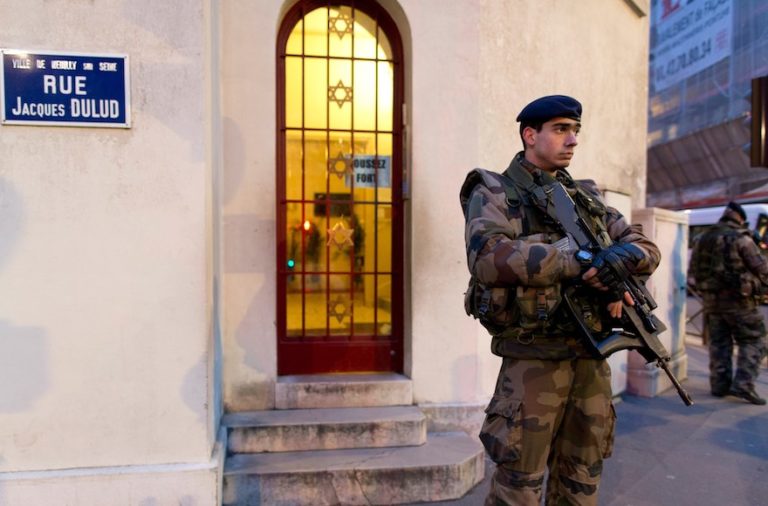
BRUSSELS (JTA) — Will security at American Jewish institutions now mirror that of Europe, with its police protection, armed guards, panic rooms and sterile zones at synagogues?
It’s a possibility that is being debated more seriously than ever before following the Tree of Life Congregation shooting in Pittsburgh Oct. 27, in which a gunman killed 11 people.
Rabbi Jack Moline, president of the Interfaith Alliance, told The Washington Post that posting armed guards outside synagogues in some places would be “prohibitive” to Jewish communal life itself.
But Gary Sikorski, director of security for the Jewish Federation of Metropolitan Detroit, told the Detroit Jewish News that the idea, suggested by President Donald Trump after the attack, is “not a bad” one.
According to European security professionals, even if Sikorski’s approach prevails it will take at least a decade and hundreds of millions of dollars before U.S. Jewry’s security infrastructure matches the European counterpart.
“The security doctrine you see in Europe is the result of decades of evolution,” said Ophir Revach, director of the European Jewish Congress’ Security and Crisis Center. “It was built on lessons from terrorist attacks in the 1960s and adjusted constantly. It’s pretty comprehensive.”
Even if a critical mass of U.S. Jewish communities decide tomorrow that they want to replicate the European model, Revach said, “optimistically speaking, it will take at least a decade to achieve.” When it comes to security, “American Jewry is at the beginning of a long journey,” he said.
In several European countries, synagogues are under constant protection of police or army troops. Most of them have volunteer guards, including armed ones. Many also have a security command room, where trained professionals or volunteers use elaborate video surveillance systems to monitor their premises, often while exchanging information with other Jewish institutions in real time.
These arrangements regularly prevent violence against congregants.
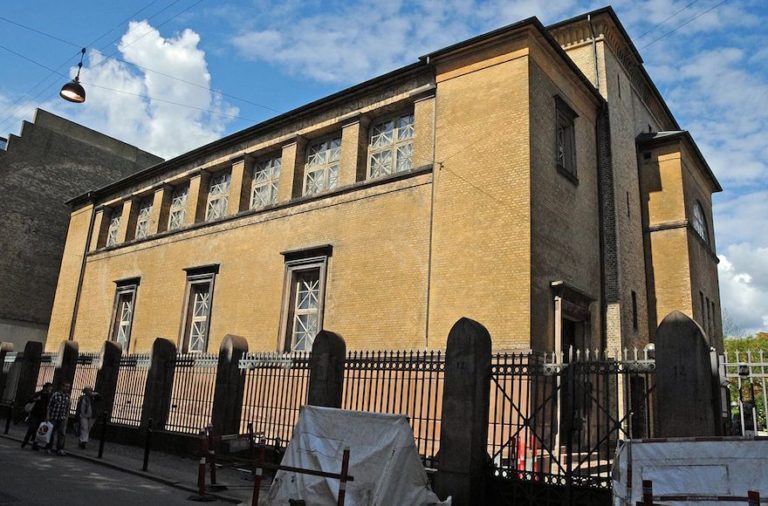
In 2015, Dan Uzan, a volunteer guard outside Copenhagen’s main synagogue, was shot dead after engaging an armed Islamist who had intended to carry out a shooting attack inside the building, where dozens of people were celebrating a bat mitzvah. His intervention allowed police to shoot the perpetrator, who never made it inside the shul.
A year earlier, a dozen-odd volunteer guards staved off dozens of rioters who had intended to storm Paris’ Synagogue de la Roquette as payback for Israel’s action’s in Gaza. As 200 worshipers waited inside, the defenders held their grounds for 20 minutes amidst a vicious street brawl with the attackers until police finally arrived at the scene.
“Dan Uzan’s death was tragic but from a security point of view, it was a system that did what it needed to do,” Revach said.
Had the Tree of Life synagogue been guarded, “this attack may have been prevented. Even armed perpetrators are deterred in a major way by guards,”Revach said.
Some American synagogues, like Har Shalom, the largest Conservative synagogue in Potomac, Md., have armed police presence during services and other events, the Washington Post noted. Community Security Service, a non-profit, has trained volunteers at dozens of synagogues, mostly in the New York area. In Teaneck, NJ, a suburb with dozens of synagogues, many have a police presence out front and CSS-trained congregants on patrol.
Others have a closed-doors policy, with visitors requesting to enter through an intercom system.
In recent years, more and more Jewish federations, the community-wide fundraising groups, have hired full-time security director for its own facilities and to advise its donor agencies. The Secure Community Network, the security arm of the Jewish Federations of North America and the Conference of Presidents of Major American Jewish Organizations, was formed in 2004. Since then, the number of federations with full-time security directors grew from two to 30, according to the Post.
Federal money is available for beefing up security at Jewish institutions. In FY 2018, Congress appropriated $50 million for nonprofit security through something called the Urban Area Security Initiative; much of the money goes to Jewish institutions.
But many American synagogues, including Tree of Life, had been leaving their doors open on Shabbat — a scenario that became unthinkable years ago in Western Europe, where jihadists have carried out several deadly attacks in recent years on Jewish targets.
Joel Rubinfeld, the president of the Belgian League Against Anti-Semitism, remembered feeling “simultaneously envious and worried” when he was greeted recently to a major New York synagogue by a concierge in his seventies — and no one else.
Before 2015, even at-risk synagogues like the Grand Synagogue of Marseille, France, had lax security and at times open doors. But the attacks in Paris that year prompted all but the most distant synagogues of Western Europe to abandon the open-door policy they used to have.
Now, European synagogues by and large employ a multilayered defensive doctrine of several threat circles in cooperation with law enforcement. “It accounts for all kinds of scenarios, not just a shooting but also a car bomb, firebombs and snipers,” Revach added.
Each scenario requires building adjustments, sometimes just adding a security barrier and at other times replacing windows with bullet-proof glass. Then there’s the need to set up international, national and regional situation rooms to help communities coordinate their activities.
“Just setting up the physical elements … takes years,” Revach said.
If American Jewry quickly ups the security arrangements around their institutions, “there’s still the issue of awareness,” said Sammy Ghozlan, a retired police commissioner and the president of the National Bureau for Vigilance Against Anti-Semitism in France. “It’s not enough to build a security. You need a community that’s drilled at maintaining it even when nothing happens year after year, so that when the threat does appear – it is met. It needs to be hardwired into you.”
American Jewry is facing a “monumental challenge” if it seeks to adopt the European security model, Ghozlan said. “It will take them at least 15 years,” he added, noting that American Jewry is “far larger and more far-flung” than its European counterpart, making the task more complicated than in France.
Ghozlan nonetheless believes that American Jews will rise to that challenge.
“We are witnessing a Europeanization of the situation in the United States for Jews,” he said. “It takes time for a worldview to change but I believe American Jews have the resources and resourcefulness to fix the security problems exposed in Pittsburgh.”
Presented by Jews United for Justice and a consortium of local synagogues, "Beyond Welcoming the Stranger" offered a Jewish approach to helping immigrants.
John Singer wants to help Marylanders of all economic backgrounds to afford ankle foot orthoses.

At Krieger Schechter Day School, joining in the later elementary or middle school isn’t a setback -- it’s a launch pad.

Israeli-Americans Rachel Goldberg-Polin and Jon Polin talked about the pain of losing their 23-year-old son, who was kidnapped and later murdered in the Oct. 7th tragedy.