

To reference an old Counting Crows tune penned by lead singer (and Baltimore native) Adam Duritz, Adam Stoler is stranded “somewhere in middle America.”
Omaha, to be precise. (Which happens to be the title of the aforementioned Counting Crows song.)
“Yeah, it’s pretty cool here,” says Stoler, 35, who grew up on Long Island, N.Y., and lives in Queens with his wife of five years, Ria Concepcion. “I’d never been to Omaha before, but they’re revitalizing the downtown area. I even found out they have three synagogues here — Orthodox, Reform and Conservative. Amazing.”
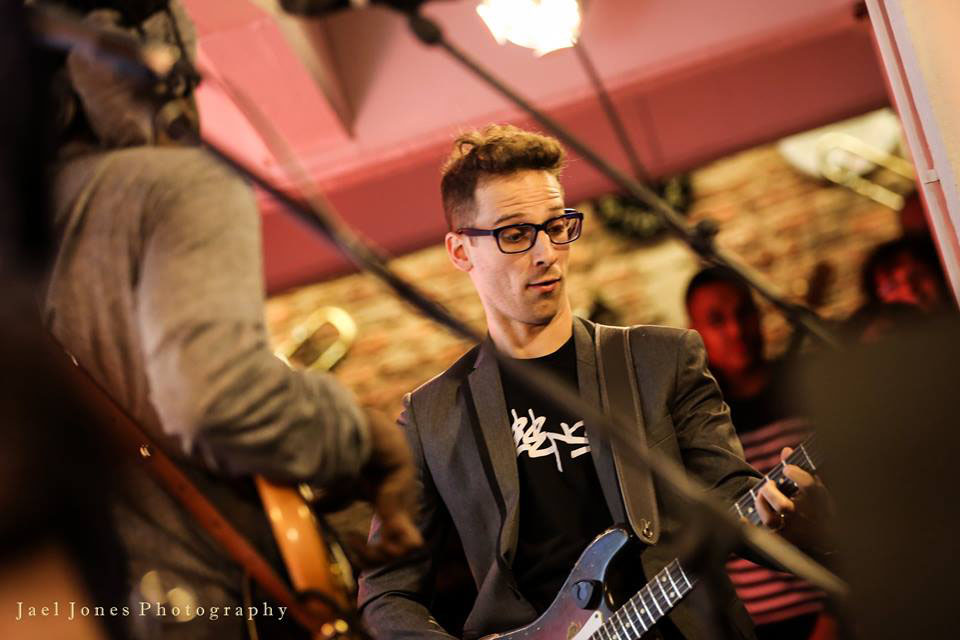
Speaking to Jmore by phone recently from the Cornhusker State’s largest city, Stoler sounds every inch the wide-eyed yet laid-back musician type. A veteran guitarist of the New York music scene, he now performs with the national touring company of “Come From Away,” the Tony Award-winning Broadway musical.
“Come From Away” is based on the true story of “Operation Yellow Ribbon,” in which citizens of the small province town of Gander in eastern Canada housed and fed nearly 7,000 stranded airline travelers in the days following the terrorist attacks of Sept. 11, 2001.
Billed as “a new musical,” the show will be presented at the Hippodrome Theatre from April 23-28, and Stoler is one of two guitarists who performs nightly with the company’s eight-piece house band.
A protégé of Grammy Award-winning jazz bassist Richard Bona, Stoler is also a composer, arranger and producer who has performed on “America’s Got Talent,” “Good Morning America,” “The CBS Early Morning Show” and NPR, as well as on Italian cabaret singer Giada Valenti’s TV special, “From Venice With Love.”
Jmore: Describe “Come From Away.”
Stoler: It’s a fantastic show, one of the mostfulfilling projects I’ve ever been associated with. The show deals with 9/11,but I think the writers were really talkingabout 9/12. It’s really about the aftermath and about helping each other. [Gander]doubled in population within hours, so how did they deal with that? They tookcare of their neighbors and realized we’re all in this together.
I don’t want to get too political here, but that’sparticularly poignant and resonant at this time. [Laughs] And I’ll leave it atthat.
Where were you on9/11?
I was living on 14th Street in Union Square [in Manhattan]. I was at [New York University] for only about 10 days, just a couple weeks shy of my 18th birthday. My brother was getting off a bus [near the World Trade Center] as the first plane hit, and like everyone else, he ran for safety. He called me and said, ‘Hey, I’m OK,’ and I said, ‘What are you talking about?’ I’d been sleeping – typical musician and college student. He said, ‘Adam, don’t you know what’s going on? Look out your window!’
I’ll never forget running outside and walking down the street southbound, and seeing the first tower fall. It was just there one second and then gone. Everyone in the street gasped. It was surreal, a pretty formative moment for me.
How’d you get involved with this show?
I first subbed for a band member on Broadway, and I just gotexcited about the work. At first, I didn’t know if I could do the show. I guessI had a little PTSD, but it was incredibly therapeutic.
Is it a tough showfor New Yorkers to watch?
My mom saw it in New York and found it difficult the firsttime around. She walked out confused and upset, but then she saw it again inL.A. and processed it better. I think it was rawer for New York audiences atfirst because so many people lived through it. It might be a little lighter foraudiences outside of New York.
How do you think Baltimoreaudiences will like it?
Everyone experiences it differently, but everyone loves this show. It’s very touching andmoving.
Is there a Jewishsensibility to “Come From Away”?
Yes, to my surprise. There’s a rabbi who’s a minor characterin the show, and a Jewish prayer – Oseh ShalomBimromav – is sung. There’s also a scene where everyone prays together –Jewish, Muslim, Christian, Hindu.
I like to think as Jews, we know the feeling of being persecuted and being the outsider. I like to think we’re inclusive and supportive of our neighbors. The main message of this show, about helping others, is a very Jewish concept to me.
How would youdescribe the music?
It’s pretty diverse. A lot of that rock-pop vibe, but also a lot of music from Gander is Irish music. That community is so isolated. Their ancestors came from Ireland, and they kept their culture and music intact. So there’s a lot of Irish bouzouki and mandolin in the show.
Had you been exposed toCeltic music before?
I really hadn’t. I didn’t really have an appreciation for it. But it’s been very cool to learn and understand. We actually have traditional Irish flute and drum and violin players in the show, which is cool. They’re not just Broadway musicians, but musicians who regularly play and live for that kind of music.
What role does theband play in the show?
We’re onstage the whole time, and there are scenes where weinteract with the cast. It’s great.
Shifting gears a bit,who do you admire among guitarists?
Oh, there are so many people. Clapton, Hendrix, for sure.Wes Montgomery, Jim Hall and John Scofield. Of course, Prince. CharlieChristian was an early influence. Nowadays, John Mayer – he’s great.
In popular music today, the guitar is not as popular or prevalent as in the past. Does that worry you?
No, it’s a pendulum that swings back and forth. People getexcited about new technologies, and that’s cool. It’s not necessarily my cup oftea. But in the end, the pendulum will swing back. People still love seeing aguy ripping on a guitar. It affects them.
What drew you to theinstrument?
Well, my father was a musician, so we had a lot of instruments in my house growing up. I started taking piano lessons at around eight and guitar lessons around 10. Being a musician is the only thing I’ve ever wanted to be.
What do you think isthe guitar’s appeal?
It’s rock ‘n’ roll, it’s rebellious. There’s somethingvisceral about it. You can bend notes that you can’t with a piano. There is aphysical element to the guitar, too. It’s percussive and rhythmic. There areparts of this show where I play an acoustic guitar and bang out a rhythm. Itravel with five different guitars for the show – two steel guitars, one nylonand two electric.
Wow. How many guitars do you personally own?
Not enough if you ask me, but my wife would say way too many. [Laughs] Between 15 and20.
Oy, where do you keep ‘em all?
It’s tough. We have a good-sized apartment in Queens, sothey’re stuck in every room all around the place.
Do you find that Broadwayand rock music blend well?
It’s all changed a lot. Broadway modernized itself and has had a renaissance. Broadway used to be pop music in the ‘20s, ‘30s and ‘40s, but now it’s a reflection of the mainstream.
What’s it like to perform on the Great White Way?
Broadway was not something I did before. I performed in bands and came up from the bar scene, and I’ve performed with some of the best musicians in the world. A rock concert is very different. It’s more like an event. But to be in a 3,000-seater and see people glued to the story and involved in what’s going on onstage, it’s a very satisfying feeling.
Without giving away too much, we have our own mini-rockconcert [during the show] that’s loud and fantastic, and something at the endthat I won’t talk about. So I get to have my cake and eat it, too. I’m not justin the pit. We’re very much part of the story.
How do you liketouring across the country and being away from home for long stretches of time?
I personally enjoy it, but I understand that some people are not built for it. But I do like it. It’s not for everyone.
Do you ever missplaying on the bands circuit?
I do miss my community of guys that I play with back home. But it’s a small price to pay to be part of this incredible, amazing show that I love.
For information, visit baltimore.broadway.com.
Filmmaker Justin Schein looks at wealth and inequality through the very real story of his late father.
For 35 years, the late Deborah Brodie, aka Bubbie Cookie, amassed a collection of over 200 Jewish ritual objects, which she used to teach her Hebrew school students with special needs.
Conceived by Columbia resident Benjamin Kintisch, "Life Review: The Hospice Musical" offers a thought-provoking and occasionally amusing perspective on mortality.

Steve Hofstetter, who will perform at Soundstage next week, recently made headlines for his social media post ridiculing some fans' warnings about Charm City's safety.