
“If at first you don’t succeed, you try again,” Israeli Prime Minister Benjamin Netanyahu said April 11 after watching the Israeli spacecraft Beresheet’s unsuccessful lunar landing attempt from SpaceIL’s control center in the central Israeli city of Yehud.
Beresheet, or Genesis, came up short in its historic touchdown bid. The robotic spacecraft, which was built by SpaceIL and Israel Aerospace Industries, was set to be the first Israeli craft — and first privately funded mission — to land on the moon. But Beresheet crashed into the lunar landscape at around 3:25 p.m. Mission control lost communications with the spacecraft when it was about 489 feet (149 meters) above the moon’s surface.
The spacecraft lost power in its main engine after sending a selfie from 22 kilometers (nearly 14 miles) above the surface of the moon, then went into a free fall toward the surface. The main engine reignited several kilometers above the surface before losing communication with the control room.
“We had a failure in the spacecraft,” said Opher Doron, general manager of IAI during a live broadcast from mission control. “We unfortunately have not managed to land successfully. It’s a tremendous achievement up until now.”
The list of moon-landing nations remains the United States, China and the former Soviet Union.
“Well we didn’t make it, but we definitely tried,” said Israeli telecommunications entrepreneur Morris Kahn, president of SpaceIL. “And I think the achievement of getting to where we got is really tremendous. I think we can be proud.”
SpaceIL, the nonprofit that founded the Beresheet program, livestreamed the landing on its Facebook page and on YouTube. At least 95,000 viewers tuned in to a live broadcast of the control room on YouTube, and the hundreds of chat messages a minute indicated that they were watching from throughout Israel, the United States and several other countries. (Some of the messages espoused anti-Israel and pro-Palestinian sentiments.)
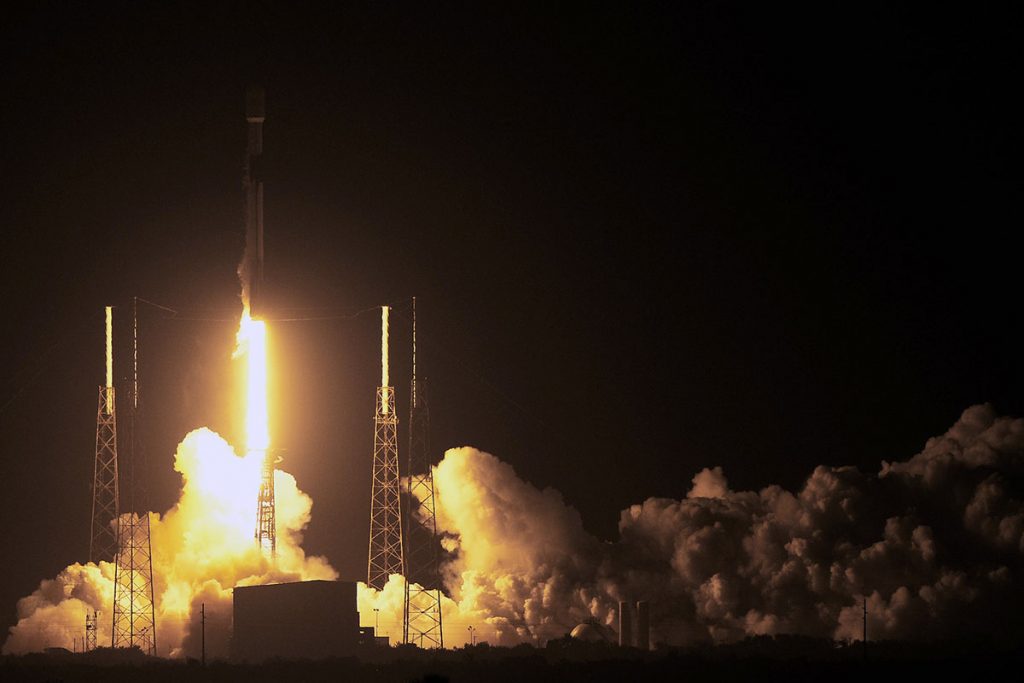
Tens of thousands of Israelis watched the launch of the spacecraft from Cape Canaveral in Florida on Feb. 21 aboard a SpaceX Falcon 9 rocket.
About 200 children and parents gathered at Israeli President’s Reuven Rivlin’s residence in Jerusalem to watch the landing. “We don’t have to be disappointed. We should congratulate ourselves on what we have achieved,” Rivlin said.
Later, he added, “Sure we didn’t land exactly like we wanted, but we landed. We are on the moon!”
Before the landing attempt, the SpaceIL team remembered Ilan Ramon, Israel’s first astronaut, who died in 2003 aboard Columbia when the space shuttle exploded during re-entry.
Beresheet was expected to touch downin the northeastern part of the Sea of Serenity, a flat area on the moon’ssurface, sometime between 10 and 11 p.m. in Israel.
Last week, SpaceIL broadcast directly fromits control room in Yehud as Beresheetsuccessfully entered the moon’s orbit in its last majorstep before the moon landing, making Israel the seventh country to enter themoon’s orbit.
Theunmanned craft’s engine was burned for six minutes, and the maneuver, thespacecraft’s seventh, was conducted with full communication between the controlroom and Beresheet. Several smaller engine burns have taken place since then toproperly orient the spacecraft and enable a proper landing.
Beresheet has traveled over 3.4 million miles in its orbits around the earth and another 1 million around the moon. The mission cost about $100 million.
Afterlanding on the moon, the spacecraft was slated to take photographs of thelanding site and a selfie to prove it touched down safely. It also was to measurethe moon’s magnetic field as part of an experiment carried out in collaborationwith the Weizmann Institute of Science in Israel.
Thespacecraft was going to leave a time capsule containing a database of hundredsof digital files ranging from details about the SpaceIL, the craft itself andthe crew of the project to national symbols, cultural items and materials collectedfrom the general public over the years, as well as the entire Bible printed inmicroscopic text on a coin. The spacecraft was not expected to return to earth.
SpaceILwas founded to compete in Google’s Lunar XPrize, a contest to see who couldbuild the first private spacecraft to reach the moon. Co-founders YonatanWinetraub, Kfir Damari and Yariv Bash submitted their application right at thedeadline, Dec. 31, 2010, and went through a few failed experiments beforebuilding the right craft.
Thesize of a compact car, the craft has been said to look like a way-out washingmachine and weighed about 1,300 pounds at launch, most of which was fuel.
TheXPrize shut down without a winner last year, but along the way SpaceIL receivedenough funding to keep going. It has worked in partnership with IsraelAerospace Industries, and its donors include the U.S. billionaire casino mogulSheldon Adelson, South African-Israeli billionaire Morris Kahn andCanadian-Israeli real estate mogul Sylvan Adams.
Theorganization also hopes to inspire Israeli kids to go into science andengineering, called the Apollo effect, by showing them that space explorationis achievable. Its educational programs have already reached more than 1million children.
The iCenter, designed to help educators connect Jewish students with Israel, also has a section devoted to SpaceIL and Beresheet, including educational resources about the moon landing and Israel’s space program.
The international Jewish news agency JTA contributed to this report.

An ambitious new educational initiative seeks to emphasize personalized learning and strengthen Israeli society.

Schwab currently serves as president of Cumberland's historic B'er Chayim Congregation.

Meanwhile, the Jewish announcer Andres Cantor will be calling his 12th straight tournament.

A former U. S. Marine, Pat Young has served as a Baltimore County Council member representing District 1 since 2022.