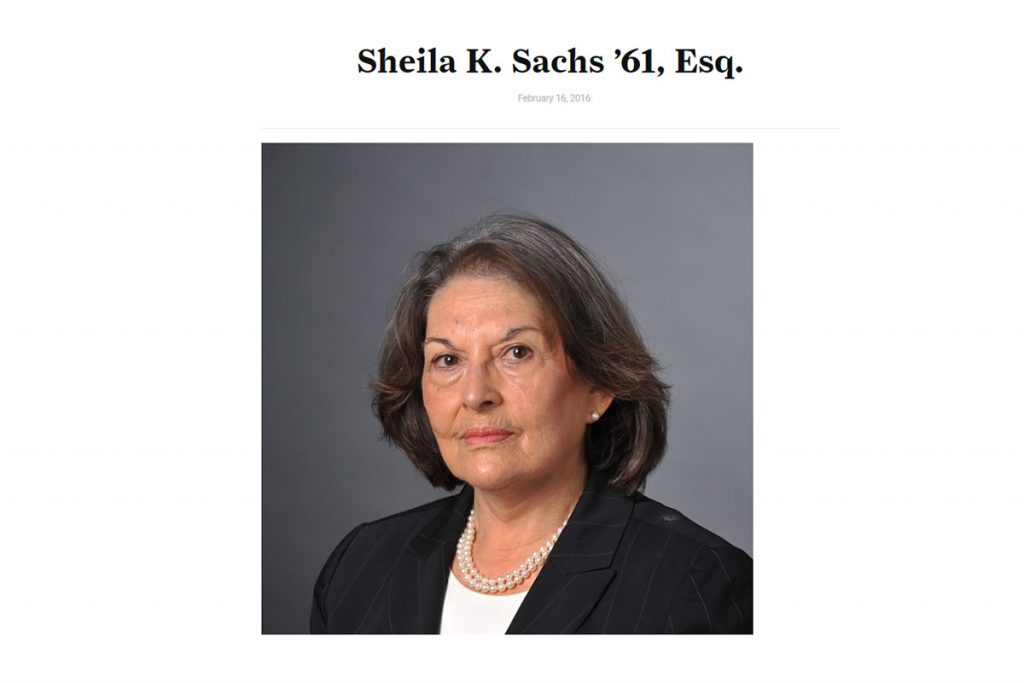
If you want some perspective on the remarkable career of Sheila Sachs, the attorney and civic leader who died this week, at 78, consider some of the following and try to imagine such a distant world as this:
When Sachs earned her law degree, in 1964, only about 4 percent of all attorneys in America were women. It was 1961 before Baltimore had its first female judge on the Supreme Bench. It was 1963 before Baltimore County had its first female prosecuting attorney.
That was the beginning of curtain time for an America where millions of females grew up, graduated school and routinely put their fullest potential on permanent hold. The most admired women in the country, year after year, were generally the wives of famous men. Think of Mamie Eisenhower, think of Jackie Kennedy.
Most women of the era becamehousewives and mothers. Sachs passed her Maryland law boards 10 days before shegave birth to the first of two children she had with Steve Sachs, who was onhis way to becoming U.S. attorney for Maryland, the state’s attorney general,and later a candidate for governor.
They were married for 58 years. They were a smart, handsome, glamorous couple seemingly chosen by the gods to do remarkable things – and then actually did them.
Sheila Sachs graduated Goucher College and the University of Maryland Law School and was one of the first women to make partner at a large law firm in downtown Baltimore. She worked in family law. You didn’t want her working against you in a divorce settlement. She turned off an incandescent smile to expose shark’s teeth.
But her law work was only part of her life. She sat on the Baltimore School Board and helped open Baltimore Polytechnic Institute’s doors to girls hungry for first-rate math and science studies. She sat on the city’s School Desegregation Task Force. In a time of upheaval in the schools, she wasn’t afraid to stand up to Roland Patterson, the contentious school superintendent.
Seven years ago she was named Baltimore Family Law Mediation Lawyer of the Year. Four years ago, the Women’s Bar Association gave her its Rita C. Davidson Award. She served as president of the Bar Association of Baltimore.
She arrived when American women were routinely handed brooms and told to wave them like batons. And she stuck around long enough to become a great attorney and a superb role model for generations of women learning they could have both a family life and a career.

A junior at Roland Park Country School, Katie Grossman writes about a recent experience that spurred her to take action to fight antisemitism.

At a time when many Jews fear appearing Jewish in public, seeing Judaism depicted correctly onscreen is reassuring, writes Jewish content creator Rabbi Yael Buechler.

Cruel, inappropriate, egomanical, outrageous and bullying are all attributes that pass for presidential these days, writes Michael Olesker.