
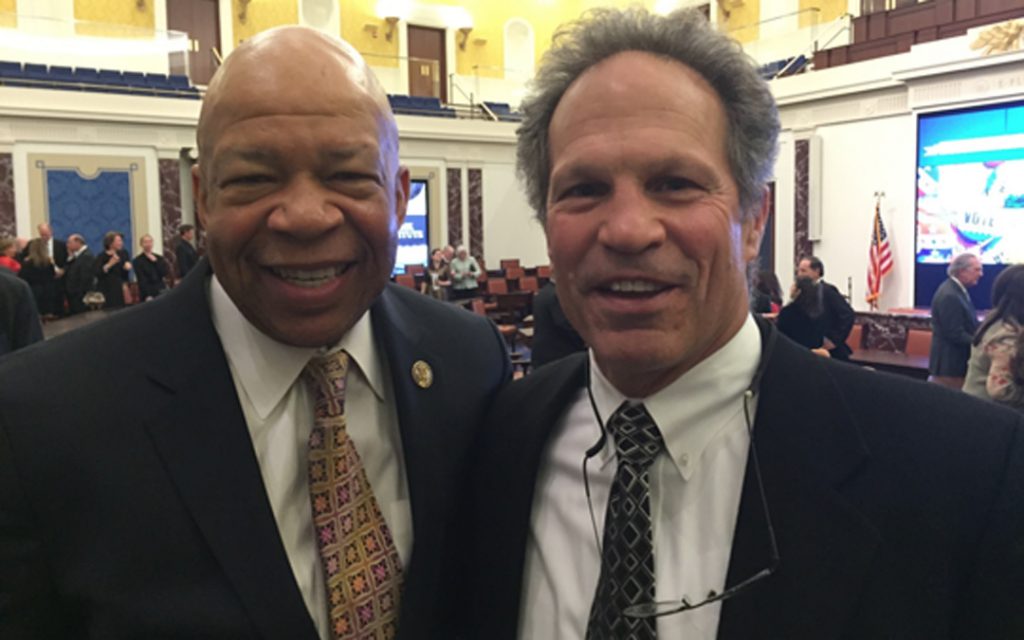
During the week Rep. Elijah Cummings goes to his grave, onthe telephone comes Dr. Jay Himmelstein to talk about an old schoolmate — and twopolitical races that go back precisely half a century to the halls of BaltimoreCity College.
The two young men were academic standouts at City, leadersof its student government, and graduates of the class of 1969.
“Elijah was a good guy, a popular guy,” Himmelsteinremembered, “and I was so sorry to hear he died. A real honorable guy, and veryinvolved in school politics. I remember him getting very passionate when hespoke. But when he finished, he was a kind, peaceful person.”
It sounds like the congressman America came to know.
Cummings, who died last week, at 68, left City for HowardUniversity, the University of Maryland School of Law, and a legendary politicalcareer as a state legislator and U.S. congressman out of West Baltimore.
Himmelstein, who grew up in Northwest Baltimore’s Cheswoldeneighborhood, graduated City’s A-Course and set out for Johns HopkinsUniversity, Harvard University’s School of Public Health, and the University ofMaryland.
He practiced medicine and still teaches at the University ofMassachusetts. He was Gov. Michael Dukakis’s physician representative to theMassachusetts Health Council, and Sen. Edward M. Kennedy’s Robert Wood JohnsonNational Health Policy Fellow.
But when Cummings and Himmelstein got together four yearsago, at the opening ceremonies for the Edward M. Kennedy Institute for the U.S.Senate at the John F. Kennedy Library, what’s the first thing they talkedabout?
“The student government elections at City,” saidHimmelstein.
The results are there in old issues of The Collegian, the school newspaper, along with reports ofHimmelstein’s standout academic record in City’s tough A-Course and hisexploits in varsity lacrosse and wrestling.
And there’s the report of Cummings’ outstanding academicrecord as well and his youthful intentions to “go to pharmacy school” for a fewyears before deciding “on medicine or law” – and his frustration with somefellow students.
“We planned a prom, which everyone signed up for,” Cummingstold The Collegian. “But then nobodypaid for tickets.”
But in that politically-charged national era, issues were alot more dramatic than prom tickets.
Himmelstein ran for president of City’s Student GovernmentAssociation. Cummings ran for president of the class of 1969.
The elections were held two weeks after the assassination ofDr. Martin Luther King Jr. and the ensuing riots. Baltimore was still diggingits way out of the ashes, and the same emotional after-effects reverberating nationallywere mirrored in schools across the land. City’s student body was more thanthree-quarters black, and a yearbook photo of the student governmentpresidential cabinet shows Himmelstein was its only white member.
And there, in that racially-charged time, Himmelstein, theJewish kid running against an African-American opponent, was elected schoolpresident.
“I don’t know how,” he says now. “I was captain of twosports teams, maybe that was it. Plus,” he laughs, “I probably promised thingsI could never deliver.”
Cummings, meanwhile, was elected president of the class of1969 – the first big political win of his career.
It was the beginning of remarkable careers for both men.

A former Baltimore Sun columnist and WJZ-TV commentator, Michael Olesker is the author of six books, most recently “Front Stoops in the Fifties: Baltimore Legends Come of Age” (Johns Hopkins University Press). He is a Baltimore City College graduate, class of June 1963,

A new biography captures the intensity and magic of the musical theater giant, writes Michael Olesker.

Melinda Michel pays tribute to the longtime Jewish community leader and volunteer who passed away on June 8 at age 68.

Jmore Editor-in-Chief Alan Feiler remembers Temple Emanuel's longtime spiritual leader, who passed away earlier this week at age 91.

Camp and youth group experiences have the ingredients for true, deep, lifelong transformation, writes Rabbi Jessy Dressin.