
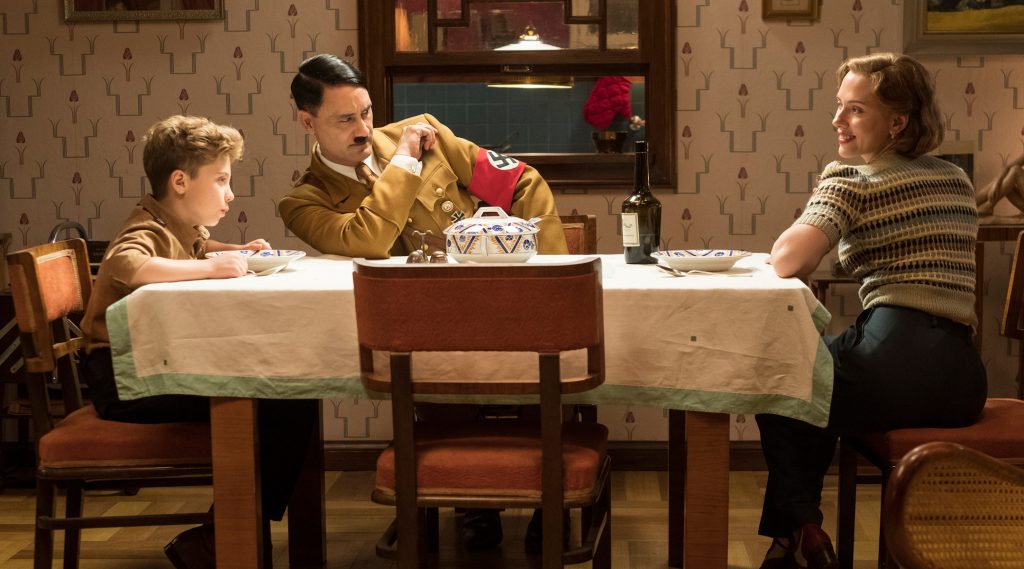
“Jojo Rabbit” plays like a spiritual descendant of “The Producers.”
I saw the new film — written and directed by New Zealand-born filmmaker Taika Waititi, a Maori Jew — at The Charles this week, in one of the smaller theaters, so completely packed with customers that the laughter and gulping at the pathos could be felt palpably.
Without the worldwide success of yesteryear’s “The Producers,”“Jojo” might’ve never been made. It’s hard to say, since many of us are stilltrying to work out our reaction to laughter in the face of Nazis and theiratrocities.
But I try to consider the rationale of Mel Brooks, whobrought us “The Producers” with its choreographed “Springtime for Hitler” gags.
When “The Producers” first came out in 1967, Brooks oncerecalled, “Every rabbi in the world sent me a letter. … [But] by using themedium of comedy, we can try to rob Hitler of his posthumous power and myths.”
At its funniest, I found “Jojo” every bit as uproarious as“Producers” – the Zero Mostel/Gene Wilder original, the Nathan Lane/MatthewBroderick stage play, and the movie based on the stage version.
That’s a lot of laughter at Hitler’s expense.
What “Jojo” has, though, that Brooks’ scripts didn’t have(because they never attempted it) is a significant part of the story devoted tothe war, and to Hitler’s monstrousness, and to the vulnerability of the Jews.
In a time of rising anti-Semitism, jokes about Nazis arekind of tricky. The journalist and film critic A.O. Scott addressed this a fewmonths ago in the New York Times,noting that such attempts represent “a form of exorcism, a way of appropriatingthe symbols of terror and hatred and stripping them of their power by exposingtheir absurd, idiotic banality.”

Roman Griffin Davis plays Johannes Betzler, a 10-year-old Germanboy who has an imaginary friend. That’s not so unusual. What’s unusual isJohannes’ choice of imaginary friend.
It’s Hitler.
It’s a great metaphor. An entire country not only embracedto Hitler and his mad ravings, but imagined he had powers far beyond reality.Johannes is called “Jojo Rabbit” because he’s as scared as a bunny and needshis imaginary friend to buck him up during a tough time at Hitler Youth camp.
Theoretically, the kid buys into the whole program. Inreality, he hasn’t got the stomach for it, especially when he finds hiding in analcove in his mother’s house a Jewish girl (Thomasin McKenzie) trying tosurvive the war’s closing weeks.
Scarlett Johansson plays Johannes’ mom. If every HitlerYouth had such a mom, it might have been a different kind of war.
Certainly a funnier one.

A former Baltimore Sun columnist and WJZ-TV commentator, Michael Olesker is the author of six books. His most recent, “Front Stoops in the Fifties: Baltimore Legends Come of Age,” was reissued in paperback by the Johns Hopkins University Press.

Journalists bear a responsibility to go beyond the headlines and social media posts to understand the past and present, writes New York University student Lucia Alonso.
The Trump administration's invoking of religion is reminiscent of the words and actions of one of history's most brutal Crusaders, writes Michael Olesker.

Like thousands of communities around the country last weekend, Pikesville demonstrated its disgust with the policies of the Trump administration, writes Michael Olesker.

Michael Olesker bids farewell to CBS News Radio, one of the most storied media outlets in history.