The late critic and essayist Alfred Kazin, obsessing asusual about being a Jew in America, wrote in one of his private journals of a poignantconversation with a gentile friend.
“Have you always felt like an American?” the friend asked.
“I’ve never felt like an American,” Kazin answered. “Notlike you do.”
The line stayed with me when I first read it several yearsago, and experience tells me it resonates with millions more in America who aren’tnecessarily Jewish but feel marginalized for their own minority status.
This week, I dug out the lines again from the 2011 book“Alfred Kazin’s Journals” (Yale University Press). I was prompted by twopowerful TV series airing now as millions of us grind our way through the longhours of isolation and reach for alternatives to the latest coronavirus updates.
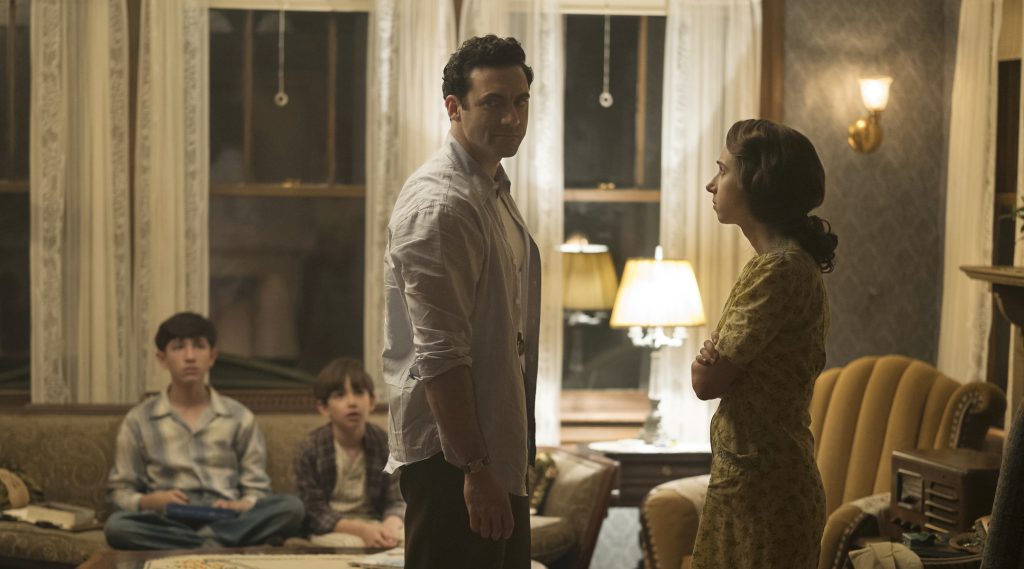
“The Plot Against America” — the six-part series based on Philip Roth’s 2004 novel and produced for HBO by David Simon and Ed Burns, who brought us “The Wire” — is dark alternative history. It’s America as it might have been had Charles A. Lindbergh defeated Franklin D. Roosevelt for the 1940 presidency.
Lindbergh, the great aviation hero of 1927, was getting cozywith Adolf Hitler by the late 1930s and urging the United States to stay out ofEurope’s battles. The only ones urging American entry into war, Lindbergh wastelling real-life “America Firsters,” were “the British and the Jewish.”
In this week’s “Plot Against America” episode, Lindbergh’sbecome president and the White House has created an Office of American Absorption.Officially, it’s designed to settle Jewish youngsters with gentile families, tosee how “real” Americans live their lives.
“So we need to be absorbed yet? We’re not American enough?”asks Alvin Levin (Morgan Spector). His young son’s leaving Jewish Newark, N.J.,and headed for a summer on an American Absorption Kentucky farm.
Levin’s questions echoed Alfred Kazin’s remark, years later,about American minorities. Did he feel American?
“Not like you do.”

And there’s another series about a slice of the Jewish-Americanexperience that’s running this week: the four-part Netflix series “Unorthodox.”It’s based on the Deborah Feldman 2012 memoir of the same name, about herescape from the Satmar Chasidic community in the Williamsburg section ofBrooklyn, N.Y.
The book stunned me when I read it five years ago, not onlyfor the tight strictures placed on females but on the explanation Feldman gotwhen she asked community elders how a loving God could have allowed theHolocaust to play itself out. It was God’s revenge on the Jews, she was told,for trying to assimilate and become more like the gentiles.
Such a notion is breathtaking, wrong-headed and cruel. Itblames mass murder on the victims themselves, as if such slaughter were alegitimate response to people’s simple desire to lead their lives as they wish,and not by someone else’s dictates.
In the television series, the explanation’s softened, andit’s said almost in passing, but the sentiment’s there. And so Esty, played byIsraeli actress Shira Haas, flees Williamsburg and its tight-knit Chasidicworld. She wants freedom.
America is freedom, no?
“Williamsburg is not America,” she says.
Like Alfred Kazin, she’s never felt American. But this time,it’s not America’s fault, so much as those Jews who willfully exclude themselvesfrom the heart of it.

A former Baltimore Sun columnist and WJZ-TV commentator, Michael Olesker is the author of six books. His most recent, “Front Stoops in the Fifties: Baltimore Legends Come of Age,” has just been reissued in paperback by the Johns Hopkins University Press.
What does it mean to be fully present with each other and the sacred, asks Maryland-born cultural anthropologist Alanna E. Cooper.
As millions mourn the passing of Stephen Colbert from the airwaves, Michael Olesker looks back on the "institution" of late-night TV.

As he gets ready to leave for California, Rabbi Daniel Cotzin Burg looks back on his time in Baltimore and his 10 years writing for Jmore.