
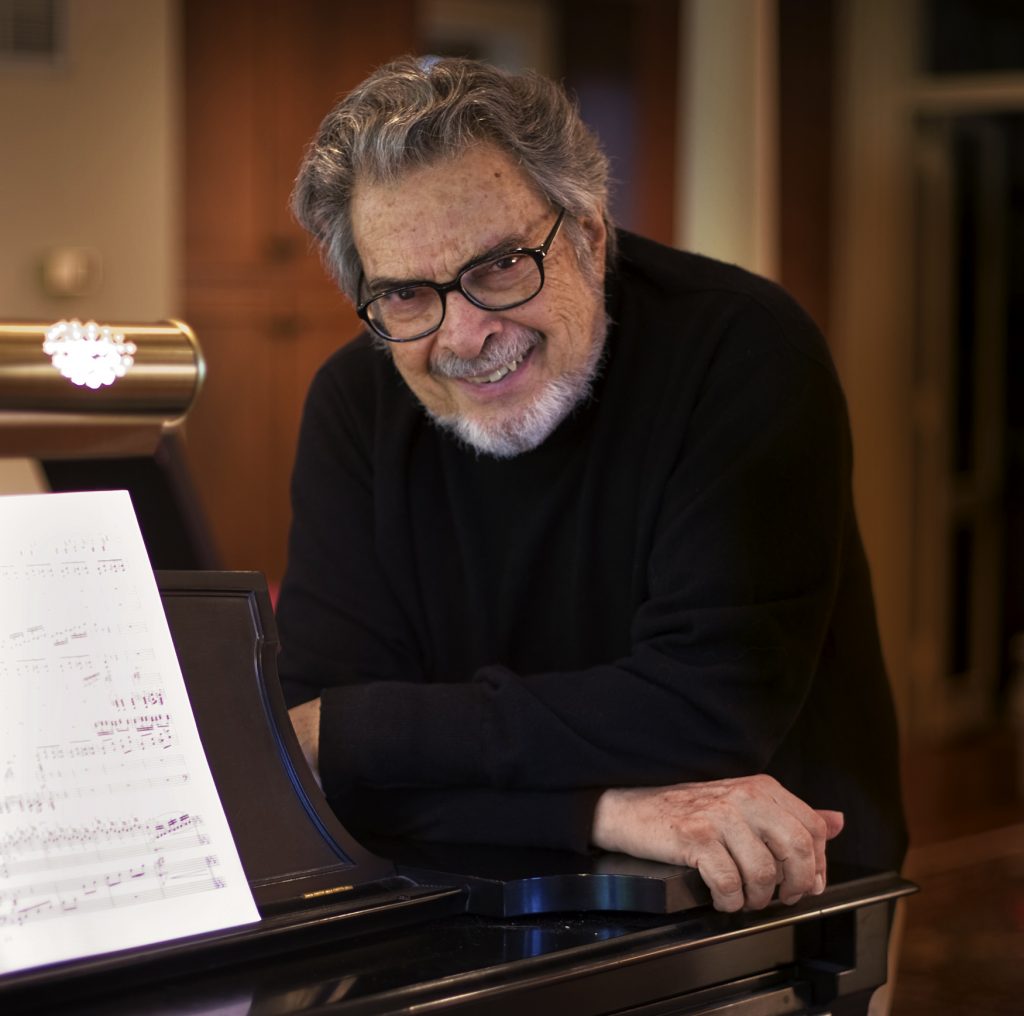
Celebrated concert pianist, conductor, pedagogue and longtime Peabody Institute faculty member Leon Fleisher died of cancer on Aug. 2. A Baltimore resident since 1959, he was 92.
“With the passing of Leon Fleisher, the music world has lost one of its towering figures,” Peabody Institute Dean Fred Bronstein said in a statement. “Our hearts go out to Leon’s wife, Katherine, and his family and loved ones.
“For members of the Peabody family, it is a deeply personal loss.”
A San Francisco native, Fleisher was the son of Bertha and Isidor Fleisher, Jewish immigrants from Poland and Ukraine, respectively, who met in New York City and eventually moved to California.
Fleisher began playing the piano at age 4 after his parents purchased the instrument for his older brother, Ray.
Fleisher was irresistibly drawn to the piano, and his first recital took place four years later. By the time he was 9, Fleisher and his mother moved to Italy, where he studied with Artur Schnabel, an Austrian-American Jewish piano virtuoso, conductor and performer whose own teacher had studied with Beethoven.
At 16, Fleisher made his Carnegie Hall debut with the New York Philharmonic. According to New York Times critic Noel Strauss, the debut “established [Fleisher] as one of the most remarkably gifted of the younger generation of American keyboard artists.”
That same year, French conductor Pierre Monteux praised Fleisher as “the pianistic find of the century.”
For the next several years, Fleisher performed with some of the premier orchestras in the United States and Europe. But by age 20, he hit a professional and personal wall and considered abandoning his musical career.
Fleisher returned to Europe and made a comeback when becoming the first American to win the prestigious Queen Elisabeth of Belgium International Music Competition. With his career reinvigorated, he performed widely throughout Europe and enjoyed renewed popularity in the U.S.
In 1954, Fleisher signed a contract with the conductor George Szell and the Cleveland Orchestra to be the main soloist on the symphony’s recordings of a series of piano concertos by Brahms and Beethoven.
Five years later, Fleisher moved to Baltimore for a teaching job at what was then known as the Peabody Conservatory. But in 1963, disaster struck when he began experiencing difficulties controlling the fingers of his right hand and was unable to tour.
Desperate to find a cure, Fleisher tried multiple treatments but none were successful. Fleisher, who later disclosed that he contemplated suicidal at the time, eventually decided to try playing exclusively with his left hand.
“I suddenly came to the realization that my connection with music was greater than just as a two-handed piano player,” he told National Public Radio in 2000.
Fleisher focused on piano pieces written for simply one hand, and increased his teaching and conducting responsibilities. His condition was eventually be diagnosed as focal dystonia, a neurological condition.
In the mid-1990s, after years of searching for treatments, Fleisher found that Botox injections and a deep tissue manipulation technique called Rolfing brought much of the control back to his right hand’s fingers.
While never regaining the same level of technical prowess, Fleisher returned to Carnegie Hall in 2003 and released an album called “Two Hands” the following year.
Three years later, Nathaniel Kahn’s documentary “Two Hands: The Leon Fleisher Story,” chronicling the pianist’s battle with focal dystonia, was nominated for an Academy Award. That same year, Fleisher was honored by the Kennedy Center.
In 2010, Fleisher and former Washington Post music critic Anne Midgette published his autobiography,“My Nine Lives: A Memoir of Many Careers in Music” (Anchor).
In his statement, Bronstein said, “Leon’s remarkable gifts as a musician, pianist, and teacher, were matched only by his charm, wit, intelligence and warmth as a human being.”
He said Fleisher “provided inspiration, guidance, and singular insight to hundreds of students over the years, both in his piano studio and on the podium. His approach to teaching went as deep as possible — showing young artists how to connect a love of music to the world around them. …
“We were extremely fortunate to have had this man in our midst for so many years. His impact here is profound and lasting, and his absence will be felt keenly throughout the Peabody community. We have lost a giant.”
Fleisher is survived by his wife, Katherine Jacobson; his children, Deborah Fleisher, Leah Fleisher (Michael Bamat), Dickie Fleisher (Kayo Ishimaru Fleisher), Paula Fleisher (Lucy Bernholz) and Julian Fleisher; and his grandchildren, Lena Compton and Harry Bernholz.
Contributions in his memory may be made to the Leon Fleisher Scholarship Fund at the Peabody Institute of the Johns Hopkins University; the ACLU of MD; and the Humane Society of the United States.
Steve Hofstetter, who will perform at Soundstage next week, recently made headlines for his social media post ridiculing some fans' warnings about Charm City's safety.
Israeli-Americans Rachel Goldberg-Polin and Jon Polin talked about the pain of losing their 23-year-old son, who was kidnapped and later murdered in the Oct. 7th tragedy.

Rabbi David Wolpe looks at the recent interest in Hollywood productions about King David and why the story is resonating now.

Directed by Johanna Gruenhut, the production is based on of the 1998 novel and 2003 film of the same name.